The Night the Whole Block Watched
Chicago, November 4, 2008 — Naomi counts the votes with her grandmother
Fifth graders read a historical fiction narrative set on Chicago's South Side on the night Barack Obama was elected the first Black president of the United States, told through the eyes of a girl who finally understands why her grandmother has never missed an election.
This sample lesson is not included in the licensed library. It shows the exact structure of every iLitBridge lesson. The 60 lessons per quarterly cycle unlocks after signing up for a subscription or becoming a licensed user if it is a school, district, or organization.
Cultural roots
The 2008 presidential election; Barack Obama's Chicago community-organizing years; the Voting Rights Act of 1965 and the generations of Black voters who fought for the ballot; Grant Park.
Objectives
- Decode multisyllabic words with common Greek and Latin roots and the suffixes -tion, -ment, -ance.
- Determine the meaning of ballot, precinct, historic, and persistence using context and word parts.
- Analyze how a narrator's point of view shapes the description of events.
- Write a response that explains a character's change, citing at least two pieces of text evidence.
Standards
- RL.5.1 — Quote accurately when explaining and drawing inferences
- RL.5.6 — Describe how a narrator's point of view influences events
- RF.5.3.A — Use combined knowledge of morphology to read multisyllabic words
- W.5.9.A — Draw evidence from literary texts to support analysis
Teacher
Two-Day Guided Reading Plan
Day 1
30 minutesPhonics · 8 min
- Flash -tion / -ment / -ance endings and name each sound.
- Model registration and announcement; box the suffix, read base + ending.
- Blending ladder: elect → election → reflection.
- Students code the eight transfer words.
Word Work — Set 1 · 7 min
- Introduce ballot, precinct, historic with student-friendly definitions.
- Show each word in its story sentence.
- Quick check: thumbs up if the sentence uses the word correctly.
Text Introduction · 4 min
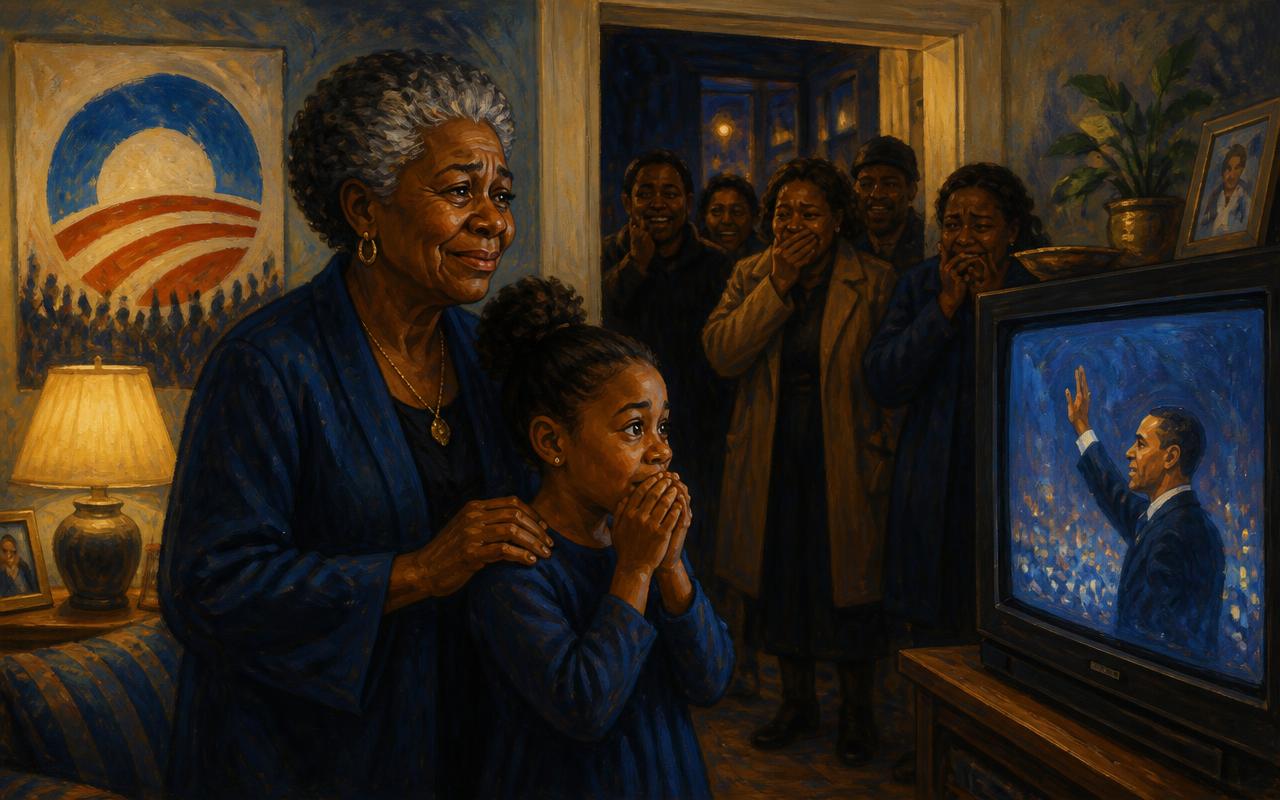
- Study the image; ask what the people are watching and how they feel.
- Give background: November 4, 2008; Chicago's South Side.
- Purpose: read to find out why this Tuesday matters to Grandma Ruth.
Read ¶1–4 · 8 min
- Students whisper-read; teacher listens in and coaches.
- Use teacher-edition stops at ¶1, ¶2, ¶3, and ¶4.
- Mark evidence of how Grandma treats the day.
Oral Comprehension · 3 min
- Ask oral questions 1–3.
- Turn and talk on the shaking hands before dismissal.
Day 2
30 minutesPhonics Review & Dictation · 6 min
- Reread the three decodable sentences for phrasing.
- Dictation: election, movement, endurance + one sentence.
Word Work — Set 2 · 6 min
- Introduce persistence, civic, witness with morphology.
- Complete the three-column word sort.
Fluency Reread · 4 min
- Partner reread of ¶1–4 with a focus on Grandma's dialogue.
Read ¶5–8 · 8 min
- Read with teacher-edition stops at ¶5–¶8.
- Mark the figurative language in ¶6.
Comprehension & Written Response · 6 min
- Ask oral questions 4–7.
- Assign one written prompt with the sentence starter.
- Score with the 3-2-1 key on the teacher plan.
Extension & enrichment
- Research one real literacy test question used to block Black voters and discuss why it was unfair.
- Map the nine miles from 79th Street to Grant Park and calculate the walk time.
- Compare this narrative with a short informational article about the Voting Rights Act of 1965.
- Write the same night from Mr. Delgado's point of view.
Family connection
Ask a family member or neighbor about the first election they remember. Bring back one sentence about how it felt and add it to the class board.
Component 1
Phonics
Focus: Multisyllabic words with the suffixes -tion, -ment, -ance (and shifting stress)
Suffixes change a word's job and often move the stress. Cover the suffix, read the base, then add the ending back and say the whole word.
Blending ladder
elect → elected → election → select → selection → reflection
Model words
e·lec·tion · gov·ern·ment · im·por·tance · reg·is·tra·tion · an·nounce·ment
Transfer words — read and code
- convention
- movement
- endurance
- celebration
- argument
- attendance
- nomination
- commitment
Decodable sentences
- The announcement came after a long night of celebration.
- Her commitment to the movement never wavered.
- Attendance at the registration table doubled by afternoon.
Routine
- Warm-up: flash -tion / -ment / -ance and name the sound each ending makes (1 min).
- Model: teacher writes registration, boxes the suffix, reads base + ending (2 min).
- Guided: students box the suffix in the eight transfer words and read by syllable (2 min).
- Apply: partner-read the sentences, second read for phrasing (2 min).
- Dictation (Day 2): election, movement, endurance + one sentence.
Component 2
Word Work & Vocabulary
ballot
nounthe paper or screen a voter uses to make an official choice
"Grandma folded her ballot like it was a letter she had waited years to mail."
Word parts: From Italian ballotta, 'little ball' — early voters dropped balls into a box.
precinct
nouna small voting district within a city or county
"Their precinct voted in the basement of the Baptist church on 79th Street."
Word parts: pre- ('before') + cinct ('bound'); a boundary drawn around a neighborhood.
historic
adjectiveimportant enough to be remembered in history
"The teacher called it a historic night before the results were even in."
Word parts: history + -ic ('having to do with'); compare historical.
persistence
nouncontinuing to try even when something is difficult
"Persistence was what got Grandma to the polls in rain, snow, and grief."
Word parts: persist + -ence ('the state of'); the suffix turns a verb into a noun.
civic
adjectivehaving to do with citizens and the duties of a community
"Voting was a civic duty in that house, the same as taking out the trash."
Word parts: Latin civis = 'citizen'; see city, citizen, civil.
witness
verb / nounto see something happen; a person who sees it happen
""You are going to witness this," Grandma said, and turned up the volume."
Word parts: wit ('knowledge') + -ness; to hold knowledge of what you saw.
Voting words
- ballot
- precinct
- civic
Character words
- persistence
- witness
- determined
Big-moment words
- historic
- celebration
- announcement
Routine
- Introduce with the image: which word matches what the people in the picture are doing?
- Student-friendly definition, then the word in the story sentence.
- Word parts: strip -ence from persistence, -ic from historic; read the base word.
- Shades of meaning: rank stubborn → determined → persistent and justify the order.
- Day 2: students use three words to explain why the night mattered to Grandma.
Component 3
Text Reading — Teacher Edition
Eight numbered paragraphs. Read ¶1–4 on Day 1 and ¶5–8 on Day 2. Clay-bordered notes are teacher-only prompts and are removed from the student packet.
Naomi Pierce had never seen her grandmother iron a dress on a Tuesday. Tuesdays were for leftovers and homework at the kitchen table. But on the first Tuesday in November of 2008, Grandma Ruth pressed her navy blue dress twice, pinned a small gold brooch to the collar, and stood in the hallway mirror the way she did before church.
Set the purpose
Teacher says: “Read to find out why this ordinary Tuesday matters so much to Grandma Ruth. Mark every detail that shows she is treating it as special.”
Watch for: Students may skip the ironing detail. Ask why an author starts with a dress.
"Get your coat," she said. "You are coming with me to vote." The polling place for their precinct was in the basement of the Baptist church on 79th Street, and the line ran out the door and halfway down the block. Naomi counted forty-one people ahead of them before she gave up counting. Nobody complained. A man near the front had brought a folding chair for anyone who needed it.
Setting and mood
Teacher says: “Forty-one people, nobody complaining, a folding chair passed forward. What does the crowd's behavior tell us?”
Watch for: Push past 'the line was long' toward 'people chose to wait; it mattered to them.'
Naomi had heard the name Barack Obama for two years, on television and on lawn signs and in the arguments men had outside the barbershop. She knew he had once worked on these very streets, sitting in church basements just like this one, asking people what their neighborhood needed. She knew he was a senator from Illinois. What she did not know was why her grandmother's hands would not stop shaking.
Background knowledge
Teacher says: “Before he ran for president, Obama was a community organizer on Chicago's South Side. Why does the author put that detail in Naomi's memory?”
Watch for: Connection that the candidate came from a place like theirs.
Inside the booth, Grandma Ruth pulled Naomi close. "My mother could not do this," she said quietly. "Not in Mississippi. They asked her to count the beans in a jar. They asked her to recite the whole state constitution. She never got a ballot in her hand, not one time in her whole life." Then she made her mark, and the machine took the card with a small mechanical sigh, and she held on to the shelf for a second longer than she needed to.
Stop and think (Day 1 close)
Teacher says: “Beans in a jar. The whole state constitution. These were real literacy tests used to block Black voters. Turn and talk: why are Grandma's hands shaking?”
Watch for: Students should link paragraph 3's shaking hands to paragraph 4's explanation.
That night the living room filled up without anyone being invited. Mr. Delgado from the second floor came with his coat still on. The twins from across the hall sat cross-legged too close to the television. Naomi's mother kept walking to the window and back. On the screen, blue and red states appeared one at a time, and the numbers climbed, and nobody sat all the way down.
Reread and predict (Day 2 open)
Teacher says: “Reread ¶1–4 for fluency, then read on. 'Nobody sat all the way down.' What does that show about how the room feels?”
Watch for: Literal readers may say people were tired; guide toward tension and anticipation.
At ten o'clock the announcement came. The room made a sound Naomi had never heard before and has never forgotten since — not exactly a cheer, more like a breath the whole block had been holding for a hundred years. Mr. Delgado put his hands over his face. The twins jumped on the couch and no one told them to stop. Somewhere down 79th Street a car horn started and did not quit.
Figurative language
Teacher says: “'A breath the whole block had been holding for a hundred years.' What is the author saying with that comparison?”
Watch for: Move students from one night to generations of waiting.
Grandma Ruth did not jump or shout. She sat very straight in the good chair with her hands folded in her lap and tears moving down her face in two steady lines. "You are going to witness this," she told Naomi, and she did not look away from the screen. "Grant Park is nine miles from this couch. Nine miles." She said the number twice, like she was measuring something bigger than distance.
Character contrast
Teacher says: “Everyone is shouting; Grandma sits still and cries. Why does the author make her the quiet one?”
Watch for: Students should infer depth of feeling, not lack of it.
Later, after the neighbors had gone home and the horns had thinned out, Naomi found the brooch on the kitchen table, still pinned to the navy dress. She understood then that her grandmother had not dressed up for the news. She had dressed up for the line, for the basement, for the small paper card — for her mother, who counted beans and never got a ballot. The historic part had not happened at ten o'clock at all. It had happened at nine in the morning, on 79th Street, forty-one people deep.
Theme
Teacher says: “Naomi decides the historic part happened in the morning, not at ten o'clock. Do you agree? Prove it with the text.”
Watch for: Accept either answer with evidence; the reasoning is the target.
Component 4
Comprehension — Oral & Written
Oral discussion questions
Literal, inferential, and critical thinking. Ask 1–3 on Day 1 and 4–7 on Day 2.
- 1.Literal¶2
Where does Naomi go with her grandmother on the morning of the election?
Listen for: The polling place in the basement of the Baptist church on 79th Street.
- 2.Literal¶4
What two things were asked of Grandma Ruth's mother when she tried to vote?
Listen for: Count the beans in a jar; recite the whole state constitution.
- 3.Inferential¶2
Why do you think nobody in the long line complained?
Listen for: They believed the wait was worth it; the folding chair shows shared purpose.
- 4.Inferential¶3–4
Why were Grandma Ruth's hands shaking before she voted?
Listen for: She is carrying her mother's denied vote with her; the moment is emotional, not routine.
- 5.Inferential¶6
What does the author mean by 'a breath the whole block had been holding for a hundred years'?
Listen for: Generations of waiting for full citizenship, released at once.
- 6.Critical Thinking¶6–7
Why does the author show Grandma Ruth sitting still while everyone else celebrates?
Listen for: Contrast highlights the weight of memory; quiet can show the deepest feeling.
- 7.Critical Thinking¶8
Naomi says the historic part happened in the morning, not at ten o'clock. Do you agree? Why?
Listen for: Reasoned position citing the line, the ballot, and the grandmother's mother; either side accepted with evidence.
Written response prompts
Each prompt ships with a sentence starter, lined student space, and a 3-2-1 scoring key.
Explain how Naomi changes from the beginning of the story to the end. Use two details from the text.
Sentence starter: At the beginning of the story, Naomi ______. By the end, she understands that ______.
Scoring: 3 = states a clear change (confusion → understanding) with two accurate details. 2 = change stated with one detail. 1 = retells without naming a change.
Why does Grandma Ruth dress up to vote? Use evidence from at least two paragraphs to explain what voting means to her.
Sentence starter: Grandma Ruth dresses up to vote because ______. The text says ______.
Scoring: 3 = connects the dress to respect, her mother's denied vote, and the brooch, with cited evidence. 2 = one connection with evidence. 1 = opinion without text support.
The full cycle has 60 lessons like this sample
Twenty lessons per grade for grades 3–5, refreshed each quarter, each with printable teacher plans, annotated teacher editions, and student packets.
Request access